
In March 2014 I took a new job in Cairo, Egypt, as the first fully expatriate senior manager to be hired by a private family-owned Egyptian oil & gas production company, with assets in the Gulf of Suez and the Western Desert. Having lived and worked in Egypt for BP some 30 years earlier, Cairo had few surprises for my wife and I, and was a refreshing change from life in London from where I had little choice but to resign from my then current position owing to major differences in opinion on corporate strategy.
Part of the attraction for the job in Cairo was that it was only a 3hr 15minute flight from London and not too pricey for a return ticket, reasonable enough to fly home to the UK for a long weekend without breaking the bank, and also that my wife and I had enjoyed our previous posting there between 1987 and 1989. Also we had fond memories of exploring a number of places off the tourist routes, and I felt that it could be fun to improve my photographic skills by documenting many of the traditional ways of life before they are gone forever.
Unfortunately the new job and posting only lasted a few months as I contracted a virus – probably MERS which is a type of Corona virus – which led to heart failure… (from which I fortunately made a more-or-less full recovery, unlike the upstream oil and gas exploration industry). Looking back, it is most likely that I probably picked up the virus whilst visiting the camel market at Birqash, some 35km northwest of Cairo.
In the little time that I had in Cairo before I became ill, the weekends quickly fell into a predictable pattern of food shopping at a local hypermarket and lying around the pool at a fairly exclusive country club – not really very exciting. (There are only so many times in a month that you can visit the Cairo Museum or the pyramids – just because you live in London does not mean that you go sightseeing in London every weekend! So whenever time permitted, I would take off into downtown Cairo and explore the off-piste parts of the Khan el-Khalili, which is the famous bazaar (or souk) in the centre of Cairo. The bazaar was established as a centre for trade in the Mamluk era (mid-13th to early 16th centuries). Whilst the bazaar district is a major tourist attraction, the many backstreets and narrow passageways are very traditional, with many artisanal workshops and traditional non-tourist trades and culture.
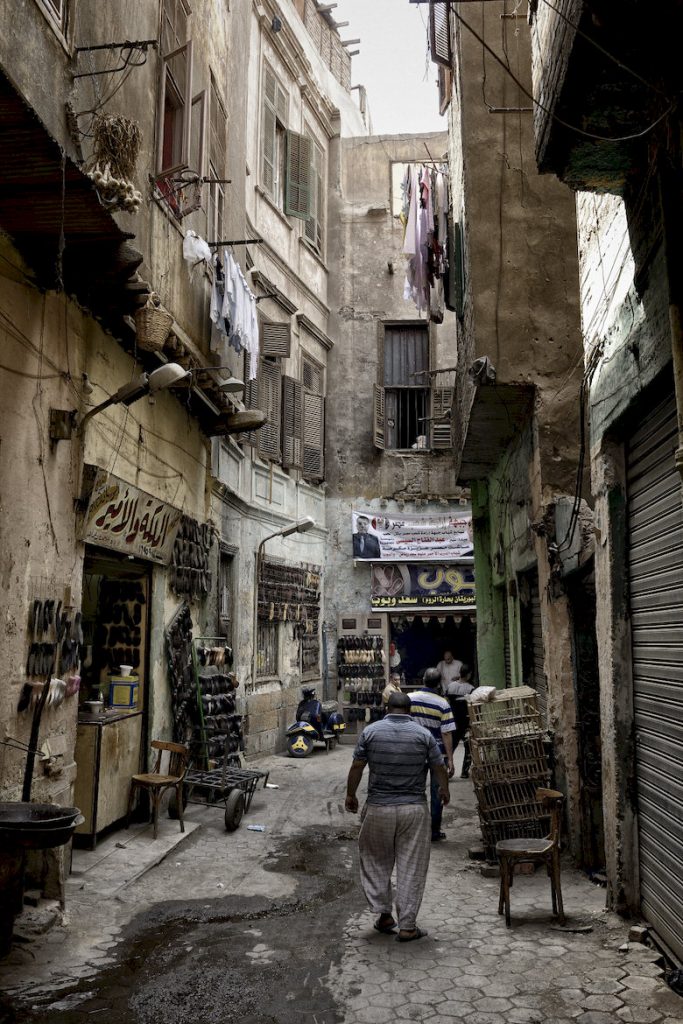
The image that I have chosen is typical of what one may find in the backstreets. This was an area of leather workers, mainly making traditional moccasin-like shoes, as well as larger leather items such as foot stools, pouffes, and of course the inevitable camel saddles for sale to tourists. Across the street from the shoe sellers in the photograph are some empty crates made from palm leaves – judging by their size these would have had poultry in them probably.
Some of the traders seem to do no work at all during the day, especially in the height of summer, but as dusk falls, or after mosque on a Friday, the whole area becomes a hive of activity, but being off the main tourist routes, such areas can look quite rundown – but in my opinion, quite photogenic too. Probably medieval London looked very similar, with all the particular trades clustered in specific areas, narrow alleyways with overhanging buildings – until of course it all burnt down in 1666 and was rebuilt on a grander scale.
Even in the height of the day, these backstreets can be quite gloomy. They are hot and grubby, often quite humid because of the water thrown down to suppress the dust and wash away some of the dirt – they all have their distinctive smells! Photographically they can be a challenge because of the high contrast between the shadows and the exposed walls in the harsh sunlight, and often photographs have to be taken quickly with a minimum of fuss as some of the traders in the less touristic areas don’t appreciate being photographed – it doesn’t hurt to ask, but one risks losing the natural spontaneity of the scene. Whilst a wide angle lens would be ideal for photographing many of the shops and workshops, I found a short zoom to be more practical particularly when including surrounding buildings, as a wide angle would have introduced too many converging verticals.
For this photograph I had to use a relatively high ISO of ISO-1000 to achieve a reasonable depth of field and shutter speed. To convey the sense of grime I desaturated the image, by merging the final edited colour version with a black & white version. The colours are present but not too bright – they are all subdued to slightly exaggerate the grimyness but I feel they more accurately convey the rundown atmosphere – so much so that one can almost smell the rich and pungent atmosphere of leather goods, sewage, dust and spices from the image alone!